


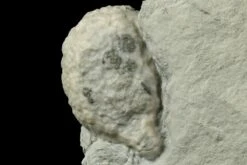

1.25″ Cystoid (Holocystites) Fossil – Indiana
Original price was: $19.00.$13.30Current price is: $13.30.
- 100% High-Quality Guarantee
- Buy with Confidence, Get Quality
- The quality solution for all your needs.
- Unbeatable Quality Guaranteed

This is a 1.25″ long fossil cystoid (Holocystites scutellatus) from the Silurian period Osgood Shale of Napolean, Indiana. It has been exposed from the rock using air abrasives. One edge of this specimen features a mollusk fossil that has also been exposed. It comes with an acrylic display stand.
Cystoids first appear in the Cambrian Period and reached peak diversity during the Ordivician and Silurian Periods. Cystoids died out at the end of the Devonian or early in the Carboniferous Period.
Cystoids resembled flowers, but were in fact animals. They had a stem that attached them to the seafloor, a theca, and brachials. The theca contained the cystoid’s vital organs and was made up of calcite plates that formed a spherical or ovate body. The brachials were the feeding arms that extended from the top of the theca, arranged in three- or five-fold symmetry, and funneled food to the mouth at their center. Cystoids and crinoids look similar but have some distinct differences. The main difference is in the shape of the main body of the organisms: cystoids had a spherical or ovate theca, while crinoids had a cup shaped calyx. Cystoids also had triangular plates at body openings while crinoids had variably shaped plates.
| SPECIES | Holocystites scutellatus |
|---|---|
| AGE | Silurian |
| LOCATION | Napolean, Indiana |
| FORMATION | Osgood Shale |
| SIZE | 1.25" long cystoid on 4.1 x 4.1" rock |
| CATEGORY | Echinoderms |
| SUB CATEGORY | Cystoid Fossils |
| ITEM | #186795 |
Be the first to review “1.25″ Cystoid (Holocystites) Fossil – Indiana”
Related products




Echinoderms


Reviews
There are no reviews yet.